
Why is Brunelleschi's Dome so important?
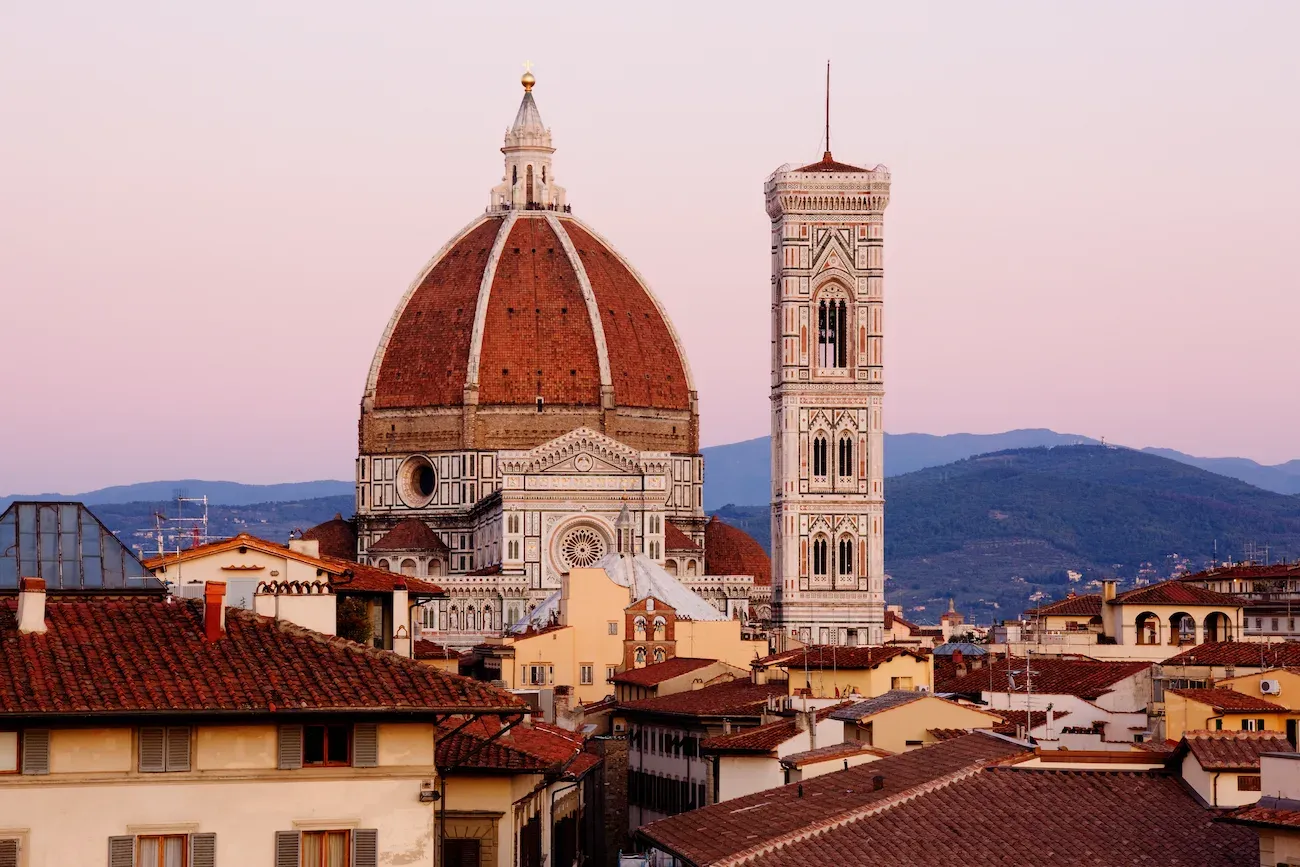
Brunelleschi's Dome (the cupola of Florence Cathedral, raised 1420 to 1436) is the largest masonry dome ever built, the first major dome in Western architecture able to rival ancient Roman work, and the symbol of the Italian Renaissance and of Florence itself. The dome solved an engineering problem that had defeated builders for over a century, established Filippo Brunelleschi, the Florentine architect and engineer, as the architect of Humanism, and gave Florence its visual icon.
Santa Maria del Fiore (Florence Cathedral) was begun in 1296 by Arnolfo di Cambio, but the question of how to roof its octagonal crossing went unanswered for more than a century. The cupola measures 54.8 metres on the outside and 45.5 metres on the inside, rising 116 metres above ground level. Built without the full freestanding wooden centring that classical methods required, it was finally completed on 30 August 1436, sixteen years after construction began.
How Brunelleschi solved an impossible engineering problem?
Four interlocking innovations carried the cupola from competition drawing to consecration in sixteen years. None of the four had a precedent at this scale.
The first was the absence of full wooden centring. No tree in Tuscany was tall enough to span 45.5 metres at a working height of 55 metres above the floor, so Brunelleschi designed the dome to rise on itself, ring by ring, with only minor temporary scaffolding rather than a full free-standing timber frame.
The second was the dome's double-shell construction. An inner load-bearing shell and a thinner outer shell, each composed of eight curved sails, work together with corridors between them. Twenty-four meridian ribs and ten parallel ribs lock the two shells, while hidden iron and stone chain-tie rings wrap the structure to absorb outward thrust.
The third was a herringbone (spina-pesce) brick bond. Vertically rotated bricks alternate with knife-laid courses in a pattern that prevailing scholarly explanations describe as self-supporting under hoop stress as the rings narrow toward the apex. Brunelleschi left no drawings, so the precise reasoning behind the bond remains partly hypothetical, but the bricks themselves number more than four million and the dome they form weighs roughly 28,000 tons.
The fourth was a set of custom hoisting machines. Force-multiplier cranes and winches driven by oxen, together with mobile platforms attached to the rising shell, lifted blocks, bricks and water to working height. Leonardo da Vinci later sketched these machines in his notebooks from observation, since Brunelleschi published nothing about them.
Why it mattered for the Renaissance?
The cupola is the first major masonry dome in Western architecture since the Pantheon in Rome, and it surpassed it. The Pantheon, built around 125 CE under Hadrian, has an interior diameter of roughly 43.3 metres. Brunelleschi's interior measure of 45.5 metres exceeded it. Before submitting his design in the 1418 competition, Brunelleschi had spent years in Rome with Donatello studying classical sculpture and Roman engineering, the Pantheon foremost among them.
In the architectural-history view, the dome marks the start of the Italian Renaissance for two linked reasons. It rediscovered classical building models that had been technically out of reach for a millennium, and it formally separated the role of the designer from the role of the builder. That separation, exemplified by Brunelleschi himself, founded the modern architectural profession.
The dome also delivered Florence a civic symbol on the scale of its ambition. The Opera del Duomo describes it as the first modern architecture able to overcome the ancient Roman buildings, completing a cathedral complex that already included the Florence Baptistery and Giotto's Campanile. The whole ensemble was inscribed as part of the UNESCO World Heritage Site Historic Centre of Florence in 1982.
Michelangelo studied the cupola before designing the dome of St Peter's Basilica in Rome, and the form recurs in Christopher Wren's St Paul's Cathedral in London and in the dome of the United States Capitol. Each is a separate engineering achievement with different proportions, but the conceptual line runs back to a single octagonal shell over Florence.