
What's inside Brunelleschi's Dome?
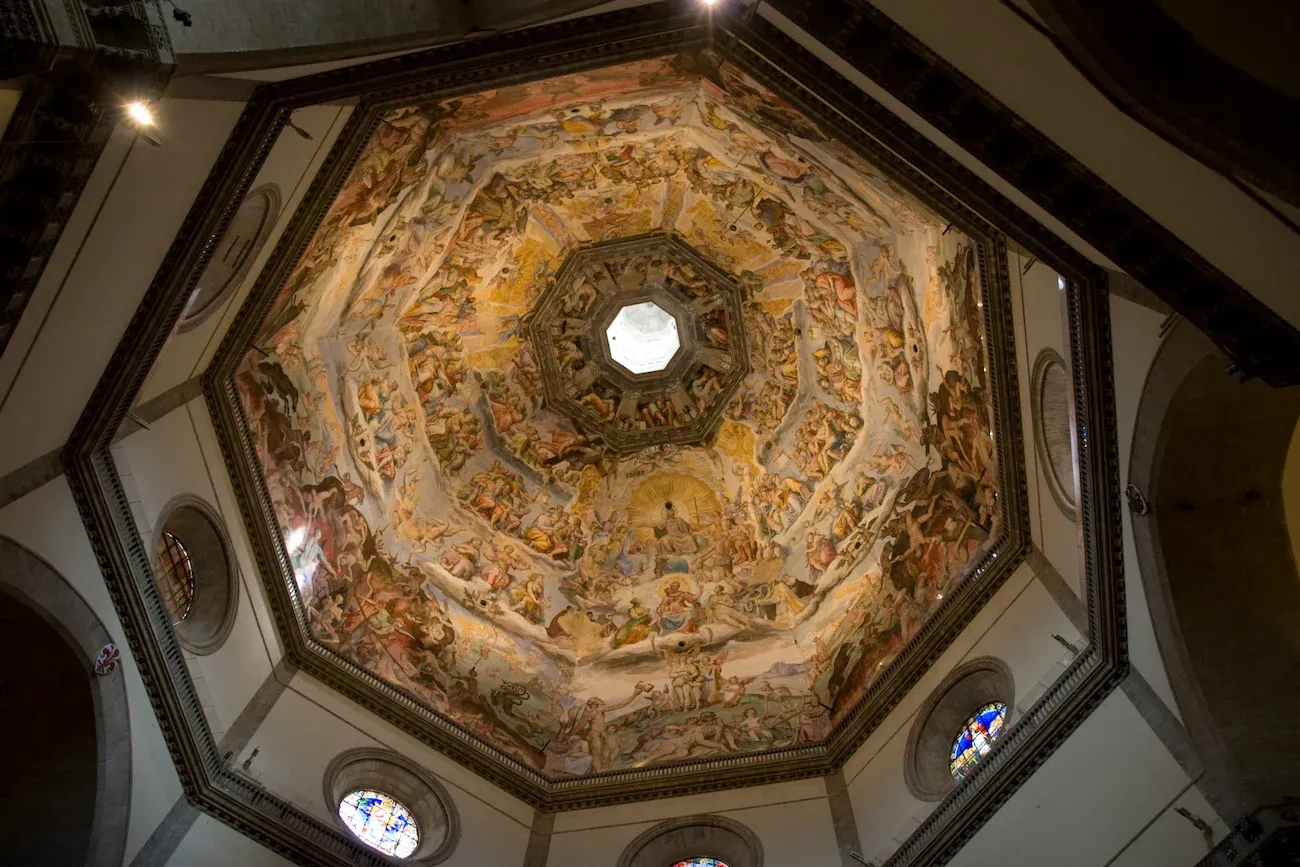
Inside Brunelleschi's dome sits the Last Judgement fresco. The 3,600-square-metre painted cycle by Giorgio Vasari and Federico Zuccari covers the inner shell. Beyond the fresco, the climb passes through the cavity between the two shells designed by Filippo Brunelleschi, the Renaissance architect. The herringbone brickwork is exposed at arm's length on the climb. The path ends at the lantern, the small structure that caps the dome at the apex.
Can you go inside Brunelleschi's Dome?
Yes, visitors can go inside Brunelleschi's dome and climb to the lantern. The route covers 463 steps inside the cavity between the inner and outer shells. No lifts or elevators serve the dome.
Entry to the climb is from the Porta della Mandorla on the north side of the cathedral. A time-slot reservation is mandatory. The required ticket is the Brunelleschi Pass, valid 3 calendar days. Once a time slot has been issued it cannot be modified or cancelled.
From 1 March 2025 a valid identity document is required, and the name on the ticket must match the document. Minors under 18 must climb with an adult.
People with heart conditions, vertigo, claustrophobia, or who are pregnant should skip the climb. The staircase is narrow and entirely enclosed between the two shells, so anyone uncomfortable in confined spaces should pick a different vantage point on the cathedral complex.
Is it worth it to go inside the Brunelleschi's Dome?
For travellers who care about Renaissance art and engineering, the climb pays off. The interior delivers things the exterior view cannot.
Visitors first reach the gallery at the base of the cupola. From there, the 3,600-square-metre Last Judgement cycle painted by Vasari and Zuccari between 1572 and 1579 fills the field of vision. The cycle includes Christ the Judge, ranks of saints, the damned, allegories of the virtues and vices, and the Elders of the Apocalypse arranged around the lantern. Photographs do not register the scale.
The herringbone brick bond is exposed all the way up. Brunelleschi devised this bond to keep the masonry self-supporting during construction, and the climb path runs through the cavity where the bricks are visible at arm's length. Few Renaissance buildings allow that kind of structural inspection.
The climb ends at the lantern. From the marble platform around it, the panorama opens onto Florence, the Arno, Giotto's bell tower, and the Tuscan hills beyond. The 463 steps are demanding. The combined payoff of art and engineering justifies the effort for most visitors.
Is there a dress code for Brunelleschi's dome?
Yes, there is a dress code for Brunelleschi's dome, since the cupola sits above the nave of an active cathedral. The rules apply to anyone entering the cathedral or starting the dome climb.
Shoulders must be covered. Sleeveless tops, tank tops, and shirts with very narrow straps are not allowed. A scarf or shawl thrown over the shoulders is enough.
Knees must be covered. Long skirts, dresses past the knee, and long trousers are all fine. Short shorts, mini-skirts, and athletic shorts that end well above the knee are not. Jeans are accepted. The rule applies to all visitors regardless of age or gender.
Hats and caps must be removed once visitors enter the cathedral, in line with standard Catholic-church etiquette. Comfortable closed-toe shoes are strongly recommended for the 463-step climb. The staircase is steep and uneven in places, and flip-flops or heels are unsuitable. Large or bulky bags and backpacks may be refused at the entrance, so light luggage is the safer choice.